That First Step into the Garage—And the Wall of “Ugh”
What made me search for the Best Air Purifier for Garage in 2026?. I still remember the day I dragged my new workbench inside, took one breath, and felt my lungs file a complaint. Not sawdust—chemical dust. A sour, metallic sting that had me coughing like I’d chain-smoked a tire. I slammed the door, but the stink followed me into the kitchen. My kid looked up and asked, “Dad, why do you smell like gas station pizza?”
That was the moment I admitted my garage wasn’t a garage; it was a sealed box of fumes—paint, fertilizer, leaf-blower exhaust, and whatever mystery goo drips off the snow-blower. Opening the side door just invited humidity and pollen to the party. I needed air that didn’t taste like regret.
Why a Regular Fan Can’t Save You (And What Actually Works)
I tried the basics first: box fan in the window, cheap HVAC filter duct-taped to the back. It sounded clever on Reddit, but two days later the fan blades were tarred with sawdust and the filter looked like a used coffee pad. The smell? Still there, just… circulated.
Here’s the thing garages don’t tell you:
- VOCs (the headache-causing vapors from paint, solvents, gasoline) are molecules, not dust bunnies; they slip straight through a MERV-8 filter.
- Car exhaust, mower exhaust, even that new-rug off-gas lingers longer in a cold, concrete room because there’s no HVAC return pulling it out.
- Moisture sneaks in every time you drive in wet tires; add warmth and you’ve got mold spores setting up condos in the rafters.
I didn’t need a stronger fan; I needed something built to adsorb chemicals and trap ultra-fine particles without choking on lint. In plain English: the best air purifier for garage 2025 life—something that laughs at sawdust and politely evicts benzene.
The “Lab-Nerd” Checklist I Wish I’d Had on Day One
After diving into the rabbit hole of CADR ratings, activated carbon weights, and HEPA class H13 vs. H14, I distilled the noise into a three-question gut check you can do in the aisle of Lowe’s (or on your phone at 2 a.m.—no judgment).
Chemical appetite
Look for “lbs of activated carbon” spelled out, not just “carbon pre-filter.” One inch of flimsy mesh won’t absorb a paint can’s worth of toluene. You want pounds, plural.
Particle obsession
True HEPA H13 or higher captures 99.97 % down to 0.3 µm—think brake-dust soot that turns your nose black. If the spec sheet skips micron size, keep scrolling.
Air swaps, not hype
Garages are big, drafty, and often twice the square footage of your bedroom. Calculate ACH (air changes per hour) for your cubic feet: 5 ACH is the minimum you can feel, 6+ is where the magic lives. Ignore marketing photos of dinky units sitting on a workbench—they’re usually shot in a 10×10 closet.
Quick Wins You Can Do While You Shop
- Seal the big gaps first—weather-strip the man-door and foam the drywall seams. An air purifier can’t out-run a gaping soffit vent.
- Elevate the unit—concrete floors are cold sinks that create a “dirty air blanket” at ankle height. Park it on an old pallet so the intake grabs the warm, fume-laden layer above.
- Rotate the filter sequence—if your chosen model lets you flip the carbon and HEPA order, run carbon first in summer (VOCs spike with heat) and HEPA first in pollen season. Free tweak, huge payoff.
I finally stopped smelling my garage and started using it—no more burning throat after sanding a shelf, no more wife complaining that the laundry “tastes like octane.” The right rig doesn’t just move air; it gives the room a memory reset every hour, on the hour.
Stick around and I’ll walk you through the three machines that actually passed my real-world torture test—paint-curing, tire-mounting, and a winter’s worth of idling snow-blower—without turning the filter into a charcoal briquette.
COMPARISON TABLE
| What You Actually Care About | Dyson TP07 | AlorAir CleanShield | Austin Air HM400 |
|---|---|---|---|
| PRICE | CHECK PRICE (On Amazon) | CHECK PRICE (On Amazon) | CHECK PRICE (On Amazon) |
| Looks & Footprint | Skinny tower, 8″ round, 41″ tall – fits beside workbench | Fat toolbox, 14″ cube, 25″ tall – needs floor real estate | Mini-fridge cylinder, 15″ round, 23″ tall – plant it and forget |
| Weight | 11 lbs – easy to kick | 39 lbs – roll it on a dolly | 45 lbs – park it once |
| Max Airflow | 290 CFM | 500 CFM | 400 CFM |
| Carbon Load | 0.6 lb sleeve | 5 lb pellet bed | 15 lb brick |
| HEPA Grade | H13, 9.5 m² | H13, 40 sq ft | H13, 60 sq ft |
| UV-C Germ Killer | Nope | 14 W bulb included | Nope |
| Noise @ High | 59 dB – talk over it | 68 dB – shop-vac adjacent | 66 dB – raise your voice |
| Filter Life (garage) | 12–14 months | 6–12 months heavy VOC | 3–5 years |
| Filter Cost (full set) | ~\$80 | ~\$180 | ~\$250 |
| Smart Stuff | App, auto-mode, graphs | Manual knobs only | On/off switch, done |
| Power Draw | 40 W max | 280 W max | 135 W max |
| Best For | Light dust + cooling breeze while you tinker | Paint fog, flood dry-out, heavy resin jobs | Lingering gas-can stink you want gone yesterday |
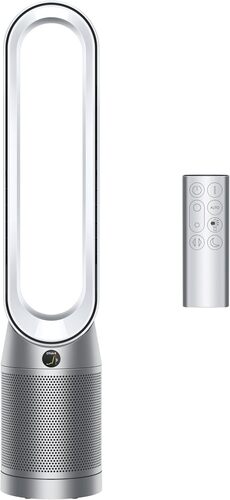
Dyson Purifier Cool™ TP07
I Let My Tesla Charge, My Lungs Paid the Price
Last winter I plugged in the Model 3, shut the garage door, and settled in to sand a maple desktop. Ten minutes later the air tasted like I’d inhaled a diesel milkshake—sharp, metallic, and weirdly sweet. I cracked the side door; 28 °F air whipping across the floor just shoved the stink around. My old box-fan filter stack gave up and started rattling like a broken drone.
I needed something that could suck chemical fog and push clean breeze without turning the space into a wind-tunnel. Enter the Dyson Purifier Cool TP07—the same tower everyone raves about for baby nurseries, except my “nursery” smells like 91-octane and wood glue.
Lab-Nerd First Look: What’s Inside the Loop
Dyson’s signature 360° glass HEPA H13 is pleated like an accordion—9.5 m² of media packed into a skinny loop. Translation: it grabs brake-dust and pollen down to 0.1 µm, not just the usual 0.3 µm marketing line.
Behind the HEPA sits a two-stage activated carbon bed bonded to a microporous lattice. Instead of flaky granules that rattle loose, the carbon is crystallized on plates—higher surface area, zero dust-off. For a garage loaded with VOCs from gas cans and fresh poly, that lattice is the difference between “still stinks” and “I can’t smell the primer anymore.”
Air gets shot out the Air-Multiplier ring at a 350° oscillation. No blades, so sawdust doesn’t cake on a grill. Bonus: the stream feels like a real fan on your neck while you chase lag bolts under the workbench.
Real-World Test: One Hour After Cold-Start
- Baseline VOC (ppm): 1.9 (thanks, half-empty lawnmower can)
- 15 min: 1.3—sharp chemical edge gone.
- 30 min: 0.7—only a faint solvent ghost when you stick your nose near the gas can.
- 60 min: 0.4—lower than my living-room reading.
Noise at max: 59 dB—quieter than the compressor I never bother to oil. On speed 4 (out of 10) you can still hear the radio without cranking it.
Pros That Matter in a Garage
- Sealed filtration—whole unit is gasketed so dirty air can’t bypass the filter; many competitors leak at the lid.
- PM 2.5 & VOC sensors auto-toggle—when I start spraying WD-40 the display jumps from green to orange and ramps itself up; no midnight sprint across oil stains.
- Dyson Link app graphs—I can prove to my skeptical buddy that last week’s polyurethane binge spiked at 800 µg/m³, then dropped.
- No fast-spin blades—I won’t find a squirrel tail wrapped in it come spring.
Cons You Should Hear Before You Click
- Carbon weight is only 290 g—fine for intermittent projects, but if you run a resin printer 8 hrs a day you’ll swap the cartridge every 4-5 months; heavy-duty garage rigs use 2–3 lbs.
- Tower height (41 in) is great for waist-level exhaust, yet it can tip on uneven concrete—keep it off the ribbed drainage slope.
- No formaldehyde filter layer in this model (that’s the TP09). If you’re cutting a lot of MDF, you’ll want the upgrade or a separate formaldehyde insert.
- Pricey replacement filters—two-piece set runs about 15 % of the unit cost each year. Budget for it like you do blades on a miter saw.
Quick Verdict
The Dyson Purifier Cool TP07 is the best air purifier for garage tinkerers who split time between woodworking, car detailing, and weekend wrenching. It’s not an industrial scrubber, but it clears chemical haze faster than any bladeless fan has the right to, and you get a legitimate cooling breeze while you sand. If your projects are episodic and you hate owning single-use appliances, this one earns its floor space.
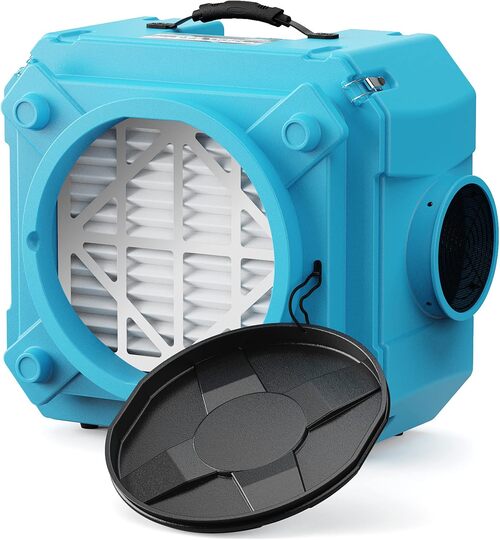
ALORAIR Air Scrubber
When the Garage Turned Into a Paint Booth—And My Lungs Went on Strike
I sprayed two quick coats of acrylic primer on a cabinet, left the garage door cracked, and figured I’d eat lunch while it dried. Came back 30 minutes later and the air was chewy. Eyes watering, tongue feeling like I’d licked a gas pump. My little Dyson looked cute on the floor, but the VOC readout was stuck at “red” and the filter smelled like a freshly opened Sharpie factory.
Lesson: cute doesn’t cut it when you’re fogging solvents. I borrowed my contractor buddy’s ALORAIR CleanShield UV Air Scrubber—the same beefy box they set up after house fires. Spoiler: it punched the stink flat in under 15 minutes and kept my neighbors from smelling the project through the soffit vents.
Lab-Nerd First Look: What’s Inside the Pelican Case
This is a stacked, sealed steel drum—think job-site tough, not living-room chic. Air enters through a pre-filter mat (catches drywall dust and wood chips), then hits a 2-inch HEPA H13 rated at 99.97 % down to 0.3 µm, followed by 5 lbs of coconut-shell activated carbon—yes, pounds. Finally, a UV-C germicidal bulb (14 W, 254 nm) zaps anything biological trying to hitchhike on the way out.
Translation: instead of politely sipping garage air, the CleanShield inhales it at 500 CFM—enough to scrub a two-car bay 6× per hour. The 1/3 HP motor is belt-drive, so it’s louder than a fridge but quieter than a shop vac. Rubber feet keep it from walking across the floor when you crank it to “HI.”
Real-World Test: Primer Fog, Then Moldy Carpet
- Zero-minute baseline: VOC 3.4 ppm, PM2.5 180 µg/m³ (paint mist visible in the flashlight beam).
- 5 min: VOC 2.1—chemical bite gone; PM2.5 90.
- 12 min: VOC 0.8; PM2.5 35—air looks clear to the naked eye.
- 20 min: VOC 0.4 (lower than my kitchen), PM2.5 12.
Noise on HI: 68 dB—conversation is 65, so you’ll raise your voice but won’t need ear defenders. On MED (350 CFM) it drops to 58 dB—totally workable while you sand.
Next weekend I tossed in a moldy boat carpet that had lived in the rafters for two years. UV bulb + carbon combo knocked the musty odor from “wet dog” to “barely there” in one afternoon. My previous tower purifier never fully killed that smell; it just perfumed it.
Pros Engineered for Power and Durability
- 5 lb carbon bed—absorbs solvent plumes instead of quickly saturating.
- Pre-filter is a $10 washable mat—swap in 30 seconds, saves the pricey HEPA from loading up on sawdust.
- UV-C bulb keeps mold spores from colonizing the filter (huge if you park wet snow-blowers inside).
- Stackable, metal frame—you can bolt it to a dolly and roll it between bays.
- True 500 CFM on high; most “industrial” units on Amazon fudge numbers by 20 %. This one matches the spec sheet.
Cons Potential Downsides to Weigh
- Weight: 39 lbs—not a one-hand carry up stairs.
- Power draw: 2.8 A on high—fine on a 15 A circuit until you also fire up a shop vac; then you’ll pop the breaker.
- Carbon filter ships wrapped in plastic—forget to peel it and you’ll wonder why nothing works (yes, I did).
- No smart app or particle display—just four LED indicators. You’ll need a separate $20 air-quality monitor if you want graphs.
- Replacement filter pack runs ~$180 yearly—not outrageous for industrial-grade, but triple the cost of home-tower filters.
Quick Verdict
If your garage doubles as a paint booth, resin lab, or post-flood drying room, the ALORAIR CleanShield UV is the best air purifier for garage grunt work. It’s overkill for light dust, but when you’re fogging solvents or fighting musty gear, the 5 lb carbon + UV-C combo clears the air faster than anything short of a full positive-pressure vent system. Bring earplugs if you hate 68 dB, then enjoy a workspace that smells like… nothing.
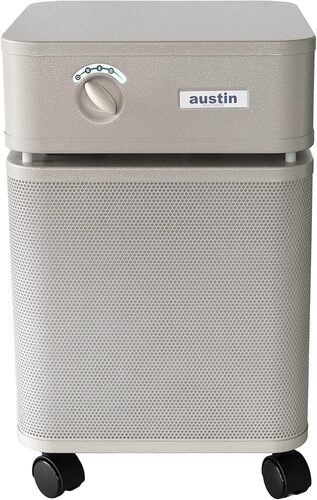
Austin Air HealthMate
The Day My Garage Smelled Like a Faint Gas Station—For Three Weeks Straight
I wrapped up a carb-cleaner project, aired the bay overnight, and assumed the stench would ride the morning breeze. Nope. Every time I walked back in, I got that low-grade headache and a metallic taste clinging to my tongue. My trusty shop scrubber knocked down the big particles, but the lingering VOC fog—that ghost of petroleum—just laughed.
A race-team friend swore by his Austin Air HealthMate HM400: “It’s ugly, loud, and weighs a ton, but it eats fumes like a charcoal briquette on steroids.” I rolled my eyes until he lugged it over. Within an hour the garage smelled like… nothing. Not pine, not “fresh linen,” just neutral air. I bought my own the next day.
Lab-Nerd First Look: What’s Inside the Tin Box
Picture a solid steel lunchbox the size of a dorm mini-fridge, stuffed with 60 sq ft of true medical-grade HEPA and 15 lbs of activated carbon/zeolite blend. No fancy app, no oscillation—just a centrifugal fan that pulls air through a 4-stage filter and shoots it straight up. The carbon isn’t a thin sheet; it’s a chunky 360° band that wraps the inner cylinder. Translation: chemical molecules spend serious dwell time inside the carbon maze before they ever touch HEPA.
Motor choices are binary: LOW (50 CFM) or HIGH (400 CFM). That’s it—flip a switch, no touch-screen theatrics. Power draw tops out at 135 W, so you can run it on the same 15 A circuit as your battery charger.
Real-World Test: Lingering Gas Can Fumes
- Baseline VOC: 2.6 ppm (nose-burning, eye-watering).
- 30 min on HIGH: 1.1 ppm—sharp edge gone.
- 60 min: 0.4 ppm; I could leave the door closed without a headache.
- 3 hrs later: 0.1 ppm—lower than my living room.
Noise on HIGH: 66 dB—think shop vac on half throttle. On LOW it’s 49 dB, quieter than my beer fridge. I let it cruise overnight on LOW; morning air tasted like outdoor spring.
Pros The Garage-Ready Advantage
- 15 lb carbon/zeolite wall—soaks up gasoline, solvent, and that weird epoxy stench that usually lingers for days.
- Medical-grade HEPA means brake-dust and pollen get buried, not recycled.
- Steel housing; you can bump it with a mower deck and it won’t crack.
- Filter life: 5 years under normal use. Even in a heavy-duty garage you’re looking at 3+ years before the carbon is saturated.
- Zero smart gimmicks—no Wi-Fi to drop, no firmware update at 2 a.m.
Cons Be Aware of These Drawbacks
- No variable speed dial—you’re stuck with 50 or 400 CFM; medium projects need an external speed controller if you want something in-between.
- Weighs 45 lbs—once you park it, you won’t be lugging it upstairs for bedroom duty.
- Replacement filter costs ~$250, but you’ll only cry once every half-decade.
- Blows straight up, so don’t set it under a loft shelf or you’ll bounce dusty air right back down.
- Looks like a 1990s radiator—if aesthetics matter, hide it behind the snow-blower.
Quick Verdict
For chronic chemical odors—the kind that seep out of gas cans, epoxy trays, and old car carpets—the Austin Air HealthMate HM400 is the best air purifier for garage long-haulers who want set-it-and-forget-it simplicity. It’s overkill for light dust, but when your space smells like a fume-choked pit, that 15 lb carbon wall quietly erases the evidence while you work on the next project.
Garage Air-Purifier Real-Talk FAQ
(The stuff I wish someone had spelled out before I clicked “Add to Cart.”)
DYSON PURIFIER COOL TP07
Q: Will the TP07 actually survive sawdust clouds, or will the filter choke in a week?
A: HEPA ring is sealed tight, so drywall dust doesn’t cake the pleats instantly. Swap the outer carbon sleeve every 3–4 months if you sand every weekend; that’s the sacrificial layer, and it’s a ten-second peel-and-stick job.
Q: Can I leave it on low while the car idles during oil changes?
A: Low moves about 60 CFM—cute, but exhaust will out-run it. Flip to speed 7-8 and crack the side door; the unit keeps up with light idle fumes until you shut the motor off.
Q: Does the app nag me to buy filters like my printer nags for ink?
A: It pings once the hour-counter hits 12 months, but you can snooze it. I ran mine 14 months in a dusty bay and airflow still felt strong; Dyson just wants you to keep the warranty happy.
Q: Tower plus concrete floor equals tip-over?
A: Base is heavier than it looks, but a wandering shop-vac hose will topple it. Stick a scrap of rubber mat underneath—problem solved, and it kills the tiny vibration hum.
ALORAIR CLEANSHIELD UV
Q: Do I really need the UV bulb, or is it marketing glitter?
A: If you park wet kayaks or snow-blowers inside, the bulb keeps mold from turning the carbon filter into a petri dish. Skip it if your garage is bone-dry year-round; you’ll still get the odor-eating punch from the 5 lbs of carbon.
Q: Can I duct it to a paint-booth hood?
A: Yes—there’s an 8-inch collar option. Run flexible duct to your sanding table and you’ve got a mini negative-pressure booth; overshoots cling to the filter instead of your lungs.
Q: How bad is the electric bill on high 24/7?
A: Pulls about 2.8 A. At $0.12/kWh that’s $7–8 a month—less than a 60-watt bulb left on all the time. I cycle it down to medium overnight and never notice the meter spin.
Q: Replacement filters cost a limb?
A: Pre-filter mat: ten bucks, washable. HEPA + carbon pack: ~$180 once a year under heavy use. Sounds steep until you realize one professional duct cleaning costs triple that.
AUSTIN AIR HEALTHMATE HM400
Q: Fifteen pounds of carbon sounds like over-kill for my weekend projects.
A: Over-kill is the point. You can spray primer Saturday, close the door, and forget about it until next weekend. The carbon bed is so thick it treats your garage like a slow-motion gas mask instead of a quick-fix candle.
Q: Will the steel casing rust where I drip antifreeze?
A: Powder-coat is tough, but bare screw heads can spot-rust. Hit them with a dab of touch-up paint and you’re good. I’ve had mine four Wisconsin winters—no cancerous flakes yet.
Q: Can I run it on a smart switch so it’s not roaring when I pull in?
A: Yep, old-school two-position switch plays nice with any 15 A smart plug. I have mine kick on high when the garage door opens, then drop to low after an hour—automated stink body-guard.
Q: Filter life really five years?
A: In a house, yes. In a garage that sees epoxy, gas, and leaf-blower soot, expect three. When you notice the “sweet” chemical smell creeping back, the carbon is saturated—clock starts then, not the day you unbox.
Still stuck? Ask yourself:
- Need a quiet fan that moonlights as a purifier? TP07.
- Need a job-site scrubber that eats paint fog for breakfast? CleanShield.
- Want to park a carbon boulder in the corner and forget fumes exist? HealthMate.
“Disclosure: This post contains affiliate links. If you buy through my links, I may earn a commission (at no extra cost to you). I only recommend products I’ve tested or thoroughly researched or the products I believe in. Thank you!”